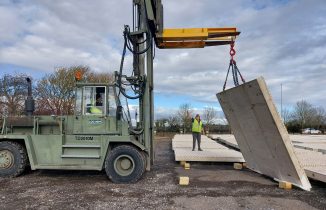


The National Civils Show took place on 26–27 November in ExCeL London, where we caught up with the industry trends for 2026. It was also a great opportunity to meet companies interested in streamlining their operations through field operations software.

The challenges facing civils companies in 2026
Topics at the show ranged from the promise of green infrastructure now threatened by politics to revealing insights on the Lower Thames Crossing.
We’ve included some highlights below, including the perspective of David Allen, executive director of CECA, who provided a general overview of the challenges facing the industry.

The CECA industry forecast
Market and planning inertia
The constraint on government budgets is having an impact. David Allen described how the highways and rail sectors have suffered a serious downturn in funding – and how this has created uncertainty about the implications on businesses. Should organisations continue to invest? Should they reduce their resources? Or should they step away from the sector entirely?
Other sectors, like water, energy, defence, and aviation are seeing many years of significant pipeline delivery – but the certainty that encourages proactive strategising across the pipeline is still missing.
David called for a tangible pipeline with clear visibility accessible to the wider supply chain community. It’s the only way to help companies invest their time and effort to ensure a sustainable return.
He questioned why it’s taking longer to get projects into contract and onto site. He wants the industry to get better at chasing out false dawns because the risks disincentivises supplier engagement. The wider adoption of Early Contractor Involvement (ECI) will help ensure that projects are better informed and that some of the potential blockers can be appropriately mitigated to ease the progression of the project to the next stages.
Legislative and financial burdens
The industry is facing new legislation that on the face of it adds financial pressure. A major concern is the proposed Landfill Tax Increase (from £4 up to £126 a tonne for inert material), which threatens the viability of schemes. David appreciated the motivation was to increase recycling, but also predicted a scenario where government policy would lead to higher quotes from subcontractors, thereby achieving no great benefit.
Skills, safety, and technology gaps
It will come as no surprise that the industry is still facing a persistent skills shortage. Recruiting an additional 100,000 new entrants per year leads to ongoing challenges, and David highlighted one initiative:
The ‘Construction Skills Mission Board’ is a joint initiative between industry and government set up under the Construction Leadership Council (CLC) to tackle critical skills shortages across the construction sector. The board has been tasked with supporting the recruitment of an additional 100,000 new entrants into the construction industry every year over the lifetime of the current parliament. CECA are currently supporting the employer representative on this board and are trying to establish the mechanisms required to fund the civil sector skills hubs, technical excellence colleges, and other new entrant activities.
Artificial intelligence
AI is transforming infrastructure, but its adoption raises critical questions: how do we ensure accountability for AI-driven decisions, manage risks like unsolicited bot access, and embed AI responsibly under NEC contracts? These are challenges the industry must address as technology accelerates.
Climate change
Climate change remains a defining challenge. While many organisations are committed to carbon reduction, inconsistent adoption across client bodies creates uncertainty for the supply chain. Tackling this requires cross-industry collaboration – and costs will arise sooner or later. Delivering excellent results on only a fraction of projects won’t achieve wider goals.
Life after tunnelling – bringing the Lower Thames Crossing to life
One of the most compelling sessions at the show explored what happens after the heavy civil engineering phase is complete.
A talk from Frank Mimnagh, project engineer, and Jag Chima, deputy tunnels and systems director on the Lower Thames Crossing illustrated the complexity of turning a major tunnelling achievement into a fully operational road network.
They went into detail about how the 4.2 km twin-bore tunnel beneath the Thames estuary was split into three main contracts: roads north of the Thames, roads south of the Thames, and the tunnels and systems.
Each brings unique challenges, from constructing new junctions on the M25 and A2 to managing power line diversions and building around 70 bridges. The tunnels themselves require advanced engineering solutions, including launch and reception structures, cross passages every 150 metres, and systems to manage high water pressures of up to six bar beneath the Thames.
Geotechnical conditions add further complexity. The alignment passes through chalk, alluvium, and Victorian landfill, requiring extensive ground treatment and innovative construction methods. Excavation will remove 2.6 million cubic metres of chalk – all of which will remain on site to create a new public space, Chalk Park.
The session highlighted that delivering a tunnel is only part of the challenge – embedding it into the network and ensuring resilience for decades to come is equally critical.
Discover more about award-winning Re-flow Field Management – helping make infrastructure companies safer, more productive, and more compliant in one piece of software.