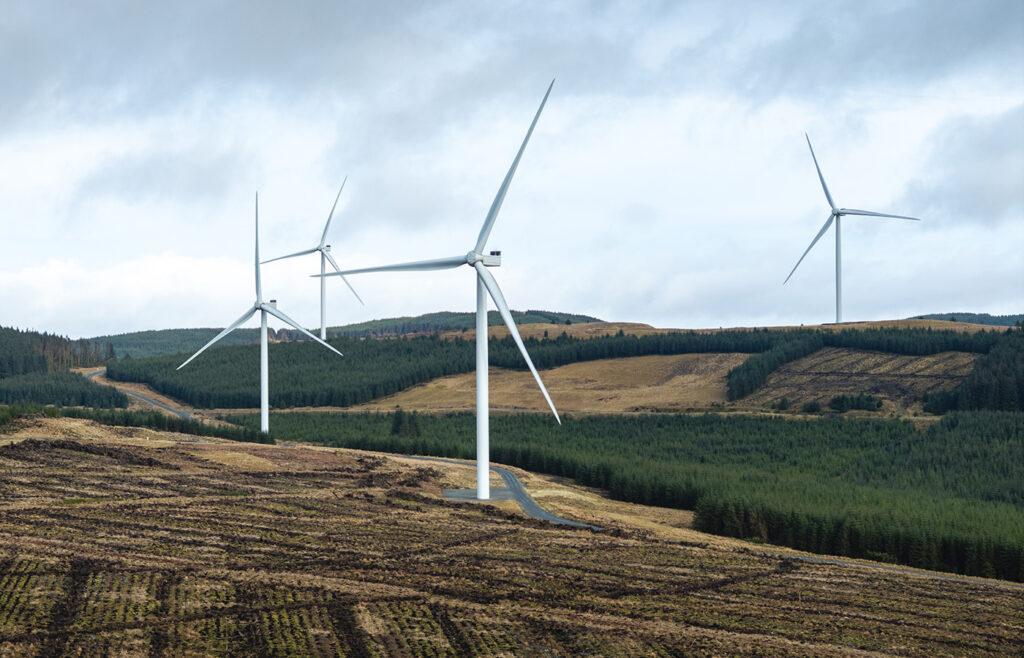
At Golticlay Wind Farm, being delivered by Farrans for RWE, one of the most significant challenges facing the project team has been the management and restoration of peat across the site.
Peatland habitats play a vital role in carbon storage and biodiversity, making their protection a key consideration throughout the development and construction of renewable energy infrastructure.
Recognising the environmental sensitivity of the site, Farrans worked closely with our client and the wind farm owner RWE, during the early stages of the project and throughout the PCSA phase to develop a comprehensive Peat Management Plan (PMP).
The PMP detailed how peat would be excavated, handled, stored and reinstated across the site, ensuring compliance with environmental requirements and best practice guidance. Given the importance of the peatland habitat, the PMP and wider strategy underwent consultation and review with key stakeholders (including NatureScot and Peatland Action) before being approved. All excavated peat has been retained on site.
The management of excavated peat on the Golticlay site involved the implementation of an innovative technique aimed at integrating the excavated peat within the peatland habitat restoration operations, as a new, sustainable ways to valorise the peat resource on wind farm sites.
The ultimate goal of this technique is to achieve the restoration of degraded peatland habitats in areas immediately adjacent to the wind farm infrastructure on previously forested sites. This involved integrating excavated peat within the traditional ground smoothing operations to raise the local water table and establish hydrological conditions which favour the revegetation of peat-forming species and re-functionalisation of the excavated peat. The technique also minimises peat handling and storage time and thus reduces the environmental impacts of excess peat handling and the drying of peat stored for long periods of time.
The innovative technique has been based on promising pilot-scale trials completed at the Camster 2 Windfarm by RWE in partnership with FLS and with the support of Farrans. The learnings from the pilot-scale trial helped optimise and shape the methodology used at this full-scale trial.
RWE and University of Highlands and Islands (UHI) have entered in a Knowledge Transfer Partnership (KTP) where a grant funded KTP Associate will undertake detailed monitoring of the pilot-scale & full-scale trial areas. If successful, this technique will be further refined and more widely adopted across our industry providing alternative approaches to optimise the management of excavated peat towards successful restoration outcomes.
Suitable locations for implementation of the innovative technique were carefully identified based on the review of local topography and hydrology, favouring areas where the peat would remain saturated and avoid drying out. In particular, the technique involved the stripping and retaining of existing turves, treatment of the tree stumps to break the linear ridges/furrow features, infilling of the area with freshly excavated peat and the placement of the existing turves over the infilled area.
“Area 7” is the largest area on site where the full-scale trial has been implemented, covering approximately 43,000m². Around 40,000m³ of peat was placed within this area alone, representing a significant contribution of the total excavated peat volume from the site.
To facilitate the movement of material to these restoration areas, temporary spur roads were constructed allowing trucks to transport peat efficiently beyond the main access routes.
Once placement was complete, the previously retained turves were carefully positioned and graded to promote rapid regeneration and preserve the site’s natural vegetation. The successful reuse of turves represents an important element of the innovative technique, to ensure that valuable peatland vegetation is retained. This is critical to the re-establishment of peatland vegetation in suitable hydrological conditions.
Delivering the innovative technique on this scale required significant expertise and experience. The works have relied on the skill and dedication of specialist excavator operators, whose understanding of working in deep peat conditions has been instrumental to the project’s success. The earthworks phase has been predominantly undertaken by our subcontractor, Gow Groundworks, whose team has played a key role in delivering this challenging element of the project.
The alternative peatland restoration technique at Golticlay Wind Farm demonstrates how careful planning, collaboration and technical expertise can support the delivery of major renewable energy infrastructure while protecting environmentally sensitive habitats.
Construction at Golticlay Wind Farm continues to progress well, with the first blades recently arriving at site and turbine erection works scheduled to commence later this summer.