
Building upon the feedback gathered from an extensive public consultation on the initial plans released earlier in the year, Manchester and Salford City Councils are expected to endorse and approve the Strategic Regeneration Framework (SRF) for the long-term transformation of the Strangeways and Cambridge areas at the respective executive committees this week (Tues 11 and Weds 12 November).
Consultation was launched earlier this year to gather feedback on the draft framework, which provides a vision for the 130 hectare city centre fringe area, will help guide future development and follows the success of GMP’s Operation Vulcan enforcement programme
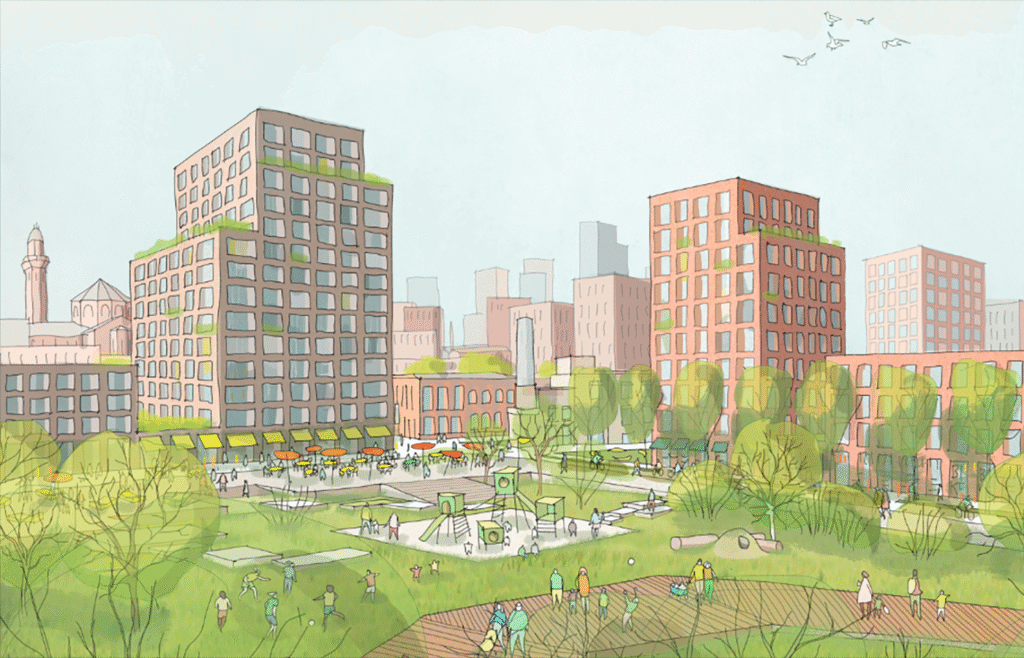
The framework is a pioneering collaboration between Manchester and Salford Councils to harness the potential of this cross-boundary regeneration opportunity, with the goal of supporting businesses in the area to grow and thrive, attracting new enterprises, and developing significant new housing and commercial space – alongside a major new 60 hectare urban park.
The SRF estimates the wider area could accommodate 7,000 new homes across seven neighbourhoods that incorporate sustainability, active travel and new green spaces. Around 1.75m sqft of commercial space could be created or improved, potentially providing 4,500 new jobs.
The first developments within the Strangeways area are already on site, including the Brewery Gardens project by Clarion on Trinity Way, providing 505 new homes – of which 132 will be for social rent and 171 for shared ownership.
While Salboy’s Waterhouse Gardens development, which will deliver 556 new homes and 30,000sqft of commercial space, has recently seen the first new residents moving in.
Consultation Results
Communities in and around the Strangeways and Cambridge area were consulted during a nine-week period earlier this year, with seven in-person events held.
Respondents to the consultation strongly supported the regeneration of the area and the vision to create safe, vibrant and sustainable communities – stressing the need for genuinely affordable homes.
Responses urged that heritage buildings be preserved and celebrated, while many wish to see the existing cultural venues should be retained.
Proposed active travel connections – including new walking and cycling routes – were welcomed though businesses made clear the need for adequate parking and loading arrangements.
There was strong support to increase green spaces and infrastructure across the regeneration area, though many respondents were naturally concerned about the implications for the existing industrial estate and local homes.
The vision for Strangeways and Cambridge
The SRF vision is supported by six objectives, with further explanation of these provided in the framework document itself:
- The local economy: providing modern and improved employment floorspace that will help new and existing businesses to grow and become more resilient.
- Creating a vibrant area: to create and improve connections between Strangeways, the city centre and the neighbouring communities in Salford and Manchester, such as Cheetham and the emerging neighbourhood at Red Bank.
- High quality development: Making sure that development is mixed, including new homes, commercial space, public realm and community spaces.
- Nature and water management: addressing long-term flood risk by creating a large new park and sustainable drainage systems.
- Getting around sustainably: Creating safe, resilient and inclusive streets in line with the Council’s Active Travel Strategy and long-term approach to radial routes such as Bury New Road and Cheetham Hill Road.
- Celebrating heritage and culture: Ensuring that as the area changes overtime, the heritage, local character and vibrancy of the area remain.
Redevelopment of this area will also be highly sustainable and the SRF support’s Manchester’s target to become a zero-carbon city by 2038, and responds to other environmental factors in the areas, including the anticipated increase in the long-term flood risk as a consequence of climate change.
In the SRF the Council restates the case to government for the relocation of HMP Manchester, noting the regeneration opportunity presented by the site and the barrier to development that the prison currently presents.
Once the draft Strangeways and Cambridge SRF document is endorsed by both Councils, the framework will become a material consideration for planning applications in this area, and as an immediate next step both councils will undertake further design of the Overbridge and Copper Park neighbourhoods set out in the SRF.
Read the Manchester City Council executive report in full
Salford City Council’s cabinet will review their own report on Tuesday 11 November
The draft SRF document was prepared on behalf of MCC and SCC by Avison Young with Maccreanor Lavington Architects, Feilden Clegg Bradley Studios, Schulze+Grassov, Civic Engineers, Useful Projects and PLACED.
The draft SRF was in part delivered using Government Funding.
Leader of the Council Bev Craig said: “The formal adoption of this framework is a milestone that we will remember for Strangeways as we move from vision to delivery and the beginning of a long-term regeneration programme for this part of our city.
“We know this is an area that has faced challenges, and we have worked closely with partners – including GMP through Operation Vulcan – to create lasting change and opportunity for these neighbourhoods.
“This is about supporting businesses, creating jobs through growth, and building the homes our residents need in neighbourhoods that they are proud of. Already we are seeing extensive development activity in this area, including significant new social rent and shared ownership housing on site now. But this is only the beginning of an incredibly exciting decade and more for Strangeways.”
Salford City Mayor Paul Dennett said: “In 2023 we entered into a joint commission with Manchester City Council to develop this Strategic Regeneration Framework for both the Strangeway and Cambridge areas.
“The development of the framework marks a significant step forward in our shared journey to transform the area into thriving, connected neighbourhoods. Informed by detailed flood modelling, the framework sets out a proactive strategy that embraces nature-based solutions and resilient design to ensure the Cambridge area can adapt to the impacts of climate change over the coming decades.
“The proposals in the framework seek to identify the best possible options for this area, including the exciting opportunity to create a new city park for all, alongside appropriate levels of mixed-use development to continue to drive sustainable growth.
“With strong community roots and a rich cultural heritage, this area is brimming with potential and together we can deliver transformational change creating new homes, jobs, and green spaces that reflect the aspirations of our residents and support a greener, fairer future.
“Earlier this year we held a nine-week public consultation so people could give their views on the SRF proposals. And it does not end there as we will continue to take on views from local people and businesses to shape our work in this area over the coming months and years.”