
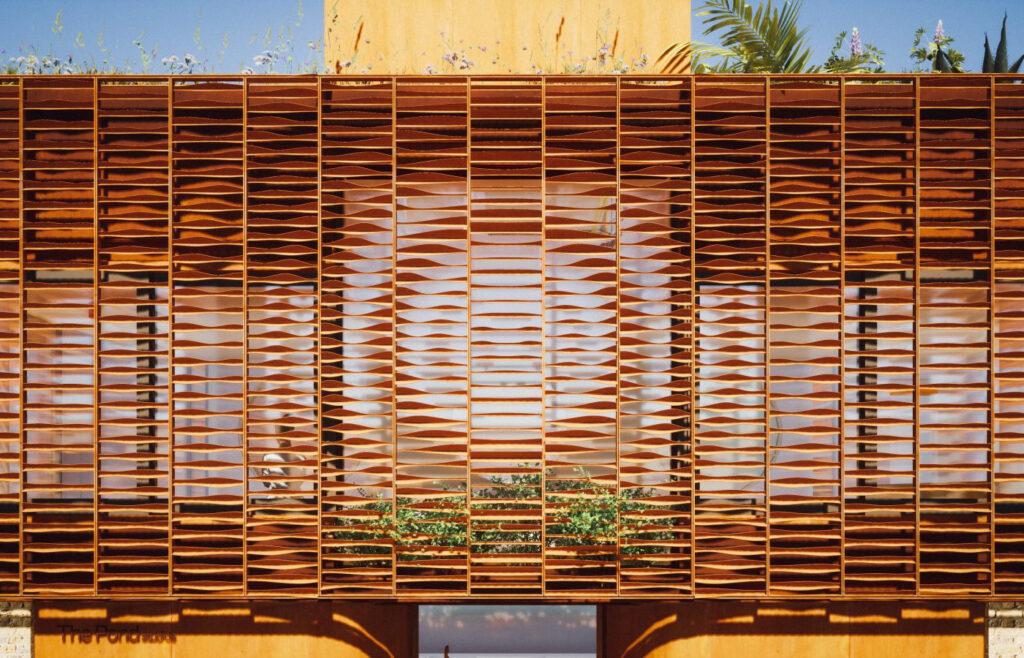
A proposed music studio for Grammy Award-winning producer Mura Masa aims to create a new creative landmark in Peckham, combining recording facilities with flexible artistic workspaces designed to support collaboration between emerging and established talent.
Plans for an innovative music and creative studio in Peckham offer a fresh interpretation of what a contemporary recording facility can be. Designed by Knox Bhavan for Grammy Award-winning producer Mura Masa, the project seeks to create a destination for musicians, artists and creatives while contributing to the area’s long-established reputation as one of London’s most vibrant cultural quarters.
Known as The Pond, the proposed building has been conceived as far more than a traditional recording studio. According to the design team, the ambition is to create a contemporary equivalent of Andy Warhol’s celebrated Factory, bringing together musicians, photographers, filmmakers, designers and visual artists within a single creative environment. The concept places collaboration at the heart of the project, encouraging interaction between internationally recognised artists and Peckham’s established creative community.
The scheme has been designed for Mura Masa, whose real name is Alex Crossan. Since emerging as one of the UK’s leading electronic music producers, he has collaborated with artists including Charli XCX, A$AP Rocky, Damon Albarn and Christine and the Queens, while earning international recognition for his production work and Grammy-winning remixing. The proposed studio reflects his aspiration to establish a permanent creative base in south London that extends beyond his own recording activities.
Located on Holdron Road in Peckham, the site occupies a compact 154-square-metre corner plot adjacent to two railway lines. It forms part of a former Victorian coal siding that is itself undergoing transformation through the proposed Peckham Coal Line, a linear park intended to connect Rye Lane with Queen’s Road Peckham. Rather than replacing the site’s industrial character, the design embraces it, responding to both its railway setting and the area’s manufacturing heritage.
The project includes the partial demolition of two existing single-storey commercial units while retaining and reusing significant elements of the current structure, including the brickwork and steel frame. This approach reduces demolition waste and preserves elements of the recently completed buildings, demonstrating how adaptive reuse can play a role even within contemporary commercial development.
Architecturally, the building adopts a bold industrial aesthetic. Weathered steel cladding wraps the ground floor, while a distinctive brise soleil screens the first-floor glazing. Beyond its visual impact, the external shading system reduces solar gain within the upper-level creative spaces while providing additional privacy for neighbouring properties. The building’s name is expressed through the façade design, drawing inspiration from filmmaker David Lynch’s analogy comparing creativity with patiently fishing in a pond for ideas.
Internally, the accommodation has been planned as a series of highly adaptable creative environments. Although the primary function will be music production and recording, the spaces are intended to support a broad range of artistic disciplines. High levels of acoustic isolation will enable professional recording, while flexible layouts allow the studios to be used by filmmakers, photographers, creative directors and other practitioners requiring adaptable production space. A planted roof terrace at third-floor level provides an additional informal setting for collaboration and social interaction.
A notable aspect of the proposal is its commitment to supporting local creative talent. Mura Masa has proposed reserving one of the production studios on a monthly or bi-monthly residency basis, making it available free of charge to emerging musicians or creatives from Peckham. The initiative is intended to remove some of the financial barriers associated with accessing professional recording facilities while creating opportunities for less established artists to work alongside experienced practitioners and develop new creative partnerships.
The project reflects Knox Bhavan’s wider approach to designing creative and community-focused buildings within its home neighbourhood of Peckham. The practice has developed a reputation for architecture that combines careful material selection with a strong understanding of place, and The Pond continues that philosophy by responding directly to its industrial context while creating a building intended to become an active participant in the local cultural scene.
If approved, The Pond would provide more than a purpose-built recording studio. It would establish a new creative destination that celebrates collaboration, adaptive reuse and architectural identity, while reinforcing Peckham’s reputation as one of London’s most dynamic centres for music, art and cultural production.