

Temporary traffic lights keep the network moving during works, but they also create avoidable operational cost and downtime, and the risk of service level breaches.
The issues are familiar across the sector:
- Crews travelling out to multiple sites simply to check battery levels
- The risk of batteries depleting faster than expected
- Supervisors and managers relying on phone calls, routine checks, or reports from crews to know the state of each asset
- Disruptions caused by any of the above – along with rising mileage, greater labour spend, and added reputational risk
Re-flow integrates traffic-light tracking with Trackit247
Our latest software release (1.10) brings with it a new integration with Trackit247 – software designed to address these challenges at their root and now possible through Re-flow.
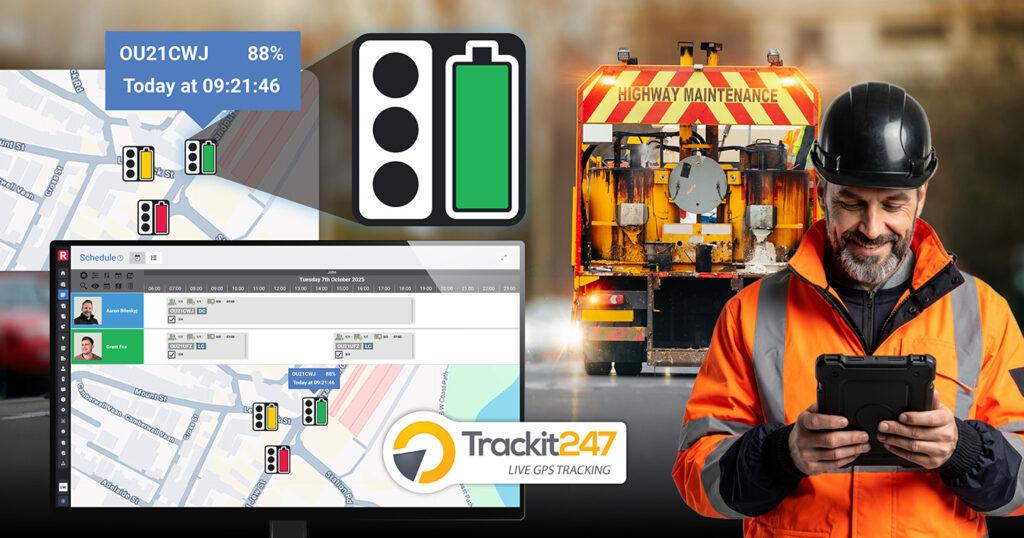
This integration brings real‑time data from temporary lights directly into our operations management software.
For leaders focused on margin protection, reliability, and contract performance, the shift is significant.
Teams gain:
- Live insight into every temporary light
Each asset shows in the map view in real time. Managers can see battery status at all times without sending a crew out to check. It becomes possible to spot issues early, plan replacements, and avoid unnecessary trips. - Automated alerts and pre‑emptive scheduling
Re‑flow monitors incoming data and triggers alerts when batteries fall below defined thresholds. It can also auto‑create battery‑replacement tasks in the schedule, reducing admin and removing lag between discovery and action. - Condition‑based maintenance instead of fixed‑cycle checks
Rather than checking lights on a weekly or bi‑weekly basis, teams visit only when needed. This reduces mileage, lowers labour demand, and focuses resource where it adds value. - A more predictable, reliable service
Fewer failures mean fewer emergency callouts, smoother workflows, and higher confidence from clients and stakeholders. For contractors working under strict performance measures, this directly supports compliance.
This is a strong integration that supports a key process and creates a more controlled, predictable, and cost‑efficient way of working – grounded in live data rather than overly manual routine.
It’s also a practical step that supports strategic goals across the sector: reducing waste, strengthening reliability, and modernising the way assets are managed across the network.
Explore other ways that field management software cuts avoidable cost and strengthens margins across the highways sector.