Appointed by London Gatwick under a £140m capital framework, Mace and lead architects Pascall+Watson are advancing the Pier 6 extension, employing offsite structural engineering and night-shift foundation works inside an active airfield.
Operating within the confines of the world’s busiest single-runway airport leaves zero margin for logistical delay. London Gatwick’s Pier 6 extension represents a cornerstone of the airport’s multi-million-pound capital investment strategy, designed to bolster airfield resilience, expand pier-served boarding capability, and streamline passenger boarding processes across the North Terminal.
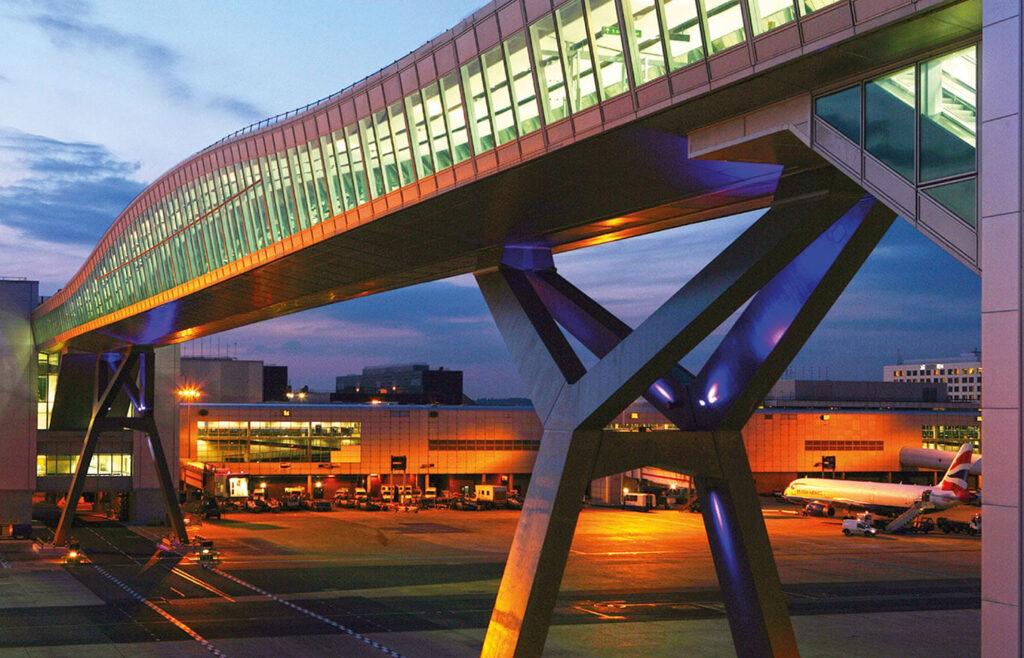
Main contractor Mace is steering delivery of the £140 million programme, building on a long-standing delivery partnership at Gatwick that famously began with the construction of the landmark Pier 6 airside passenger bridge. For the current expansion, Mace is working closely with aviation architects Pascall+Watson, structural frame specialists B&K Structures, and geotechnical contractor Bachy Soletanche to execute a complex airside build directly adjacent to operational aircraft stands.
The architectural masterplan by Pascall+Watson extends Pier 6 westward, introducing dedicated aircraft stands equipped with automated boarding gates, modern departure lounges, and segregated arrivals and departures corridors. By reconfiguring the pier footprint to accommodate modern narrow-body and wide-body aircraft, the scheme substantially cuts reliance on remote coaching operations. Passengers transition directly from terminal to aircraft via climate-controlled, glazed boarding bridges, enhancing turn-around times for commercial airlines.
Airside geotechnical works presented early delivery hurdles. Foundation specialist Bachy Soletanche executed the substructure package, drilling large-diameter contiguous and rotary bored piles in immediate proximity to live taxiways. Piling rigs, concrete supply logistics, and spoil removal were scheduled around peak apron flight windows—frequently shifting heavy plant movements to night-shift possessions under stringent Foreign Object Debris (FOD) management protocols and Gatwick Airfield Operations supervision.
Above ground, the superstructure strategy leans heavily on Design for Manufacture and Assembly (DfMA) principles to suppress on-site delivery risks. Specialist subcontractor B&K Structures was engaged to engineer, manufacture, and erect the structural framing system. Utilizing pre-engineered timber and structural steel components manufactured offsite, the superstructure modules are transported airside in consolidated deliveries and craned directly into position.
This offsite methodology delivers twin benefits: it dramatically accelerates the build timeline while reducing the headcount, tooling, and vehicle movements required on the active apron. The hybrid timber and steel structural approach also reduces embodied carbon across the pier’s structural frame, directly supporting London Gatwick’s long-term environmental and sustainability mandates.
Mace’s operational site team maintains unbroken interface management with air traffic control, ground handling teams, and emergency services. Safety buffers, anti-blast hoardings, and temporary perimeter re-routing ensure that apron service vehicles and passenger aircraft continue unimpeded just meters from active tower cranes and MEP installation crews.
On site, the project team has transitioned from substructure sign-off to superstructure frame assembly and external envelope glazing. The subsequent delivery phase will concentrate on building services integration, baggage system connections, and final airside systems commissioning ahead of operational trials with Gatwick’s airline partners.